Source-aligned editorial review. No named clinician review is claimed unless a page explicitly identifies one.
Quick answer
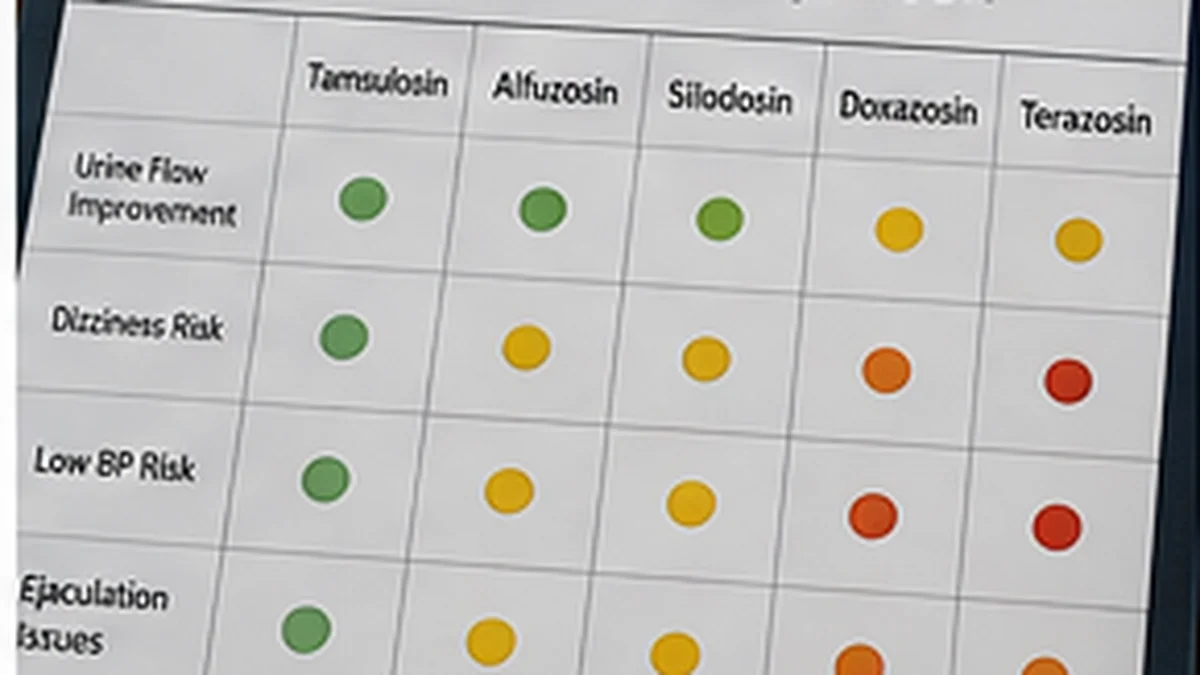
A useful BPH medication comparison should compare mechanism, symptom role, prostate-volume effect, PSA implications, blood-pressure considerations, sexual-function considerations and labeled use without pretending those dimensions add up to a universal winner.
Compare two medication options
Choose two treatments. The output is a side-by-side educational profile, not a recommendation.
What the matrix is designed to expose
Medication choice can look deceptively simple when every option is reduced to “helps BPH.” The more useful distinctions concern what a treatment is trying to change and what trade-offs follow from that mechanism. Alpha blockers are generally used for symptom relief and do not shrink prostate tissue. Finasteride and dutasteride act on androgen pathways and are used when prostate enlargement itself is an important treatment target. Tadalafil occupies a different niche because its BPH indication overlaps with erectile-function treatment.
The matrix also highlights why PSA history cannot be separated from medication history. Finasteride and dutasteride can lower serum PSA substantially. A clinician interpreting a new result needs to know the medication, the duration of treatment, the on-treatment baseline and the pattern over time.
Why the tool does not produce a score
A single numerical score would create false precision. A person who prioritizes avoiding dizziness may value a treatment characteristic differently from someone focused on prostate-volume reduction, erectile function or avoiding a procedure. The tool therefore shows trade-offs rather than converting them into an algorithmic verdict.
| Decision dimension | Why it matters |
|---|---|
| Mechanism | Separates symptom relaxation from prostate-volume treatment and PDE5 inhibition. |
| Expected role | Clarifies whether the treatment is mainly about faster symptom relief, longer-term prostate change, or BPH/ED overlap. |
| PSA context | Flags medications that change how PSA trends are interpreted. |
| Blood pressure | Prompts review of dizziness, orthostasis, antihypertensives and fall risk. |
| Sexual function | Separates ejaculation, libido and erectile-function questions rather than treating “sexual side effects” as one thing. |
How to read a medication comparison without overinterpreting it
Two drugs can both be appropriate BPH treatments while solving different parts of the problem. Tamsulosin, for example, belongs to a symptom-relief class. Finasteride and dutasteride belong to a prostate-volume strategy. Tadalafil adds a separate dimension because it can be used for BPH while also treating erectile dysfunction. A useful comparison starts by asking whether the two options are competing for the same role or whether they might appear in different stages of the same treatment plan.
Timing also matters. Faster symptom relief and longer-term structural change are not interchangeable outcomes. Someone can reasonably value quick improvement while a clinician simultaneously considers whether prostate size, progression risk or retention history creates a reason to think about a longer-horizon treatment. The matrix keeps those questions separate so one advantage is not silently used to imply superiority on every other dimension.
Why prostate size and PSA belong in the same decision framework
Prostate size can influence why a 5-alpha-reductase inhibitor enters the conversation, while PSA interpretation changes after those medicines are started. That makes medication history part of laboratory interpretation, not just treatment history. A reader comparing finasteride or dutasteride with an alpha blocker should therefore understand that the difference is not merely side effects or speed. It can affect how follow-up data are read months later.
The tool also avoids direct cross-trial adverse-event rankings. Drug-label percentages come from different studies with different populations and designs. Presenting those numbers side by side as if they came from one randomized head-to-head experiment would manufacture precision that the source evidence does not provide. Instead, the tool flags the labeled concern and links to the deeper page where the context can be examined.
Frequently asked questions
Does this tool tell me which BPH medication is best?
No. It compares characteristics that can matter in a treatment discussion. Individual suitability depends on symptoms, prostate size, blood pressure, other medicines, sexual-function priorities and clinical findings.
Why are alpha blockers grouped differently from finasteride and dutasteride?
They work through different mechanisms. Alpha blockers relax smooth muscle, while 5-alpha-reductase inhibitors affect prostate hormone metabolism and can reduce prostate volume over time.
Does tamsulosin shrink the prostate?
Tamsulosin is an alpha blocker and is used for symptom relief rather than prostate-volume reduction.
Why does PSA appear in the finasteride and dutasteride comparison?
Both 5-alpha-reductase inhibitors can substantially lower PSA, so clinicians use treatment history and a new on-treatment baseline when interpreting results.
Why is tadalafil included in a BPH medication tool?
Tadalafil has a U.S. labeled once-daily regimen for BPH and for men with both BPH and erectile dysfunction.
Can I compare side-effect percentages directly between different drug labels?
Not reliably. Trials differ in design and population. The tool therefore emphasizes labeled concerns and decision themes rather than presenting cross-trial percentages as a ranking.
Can I use the matrix to switch medicines myself?
No. Stopping or switching prescription treatment should be discussed with a clinician.
Does the tool include combination therapy?
It flags when combination treatment may enter a discussion, but it does not decide whether combination therapy is appropriate for a particular person.
What if my main problem is nocturia?
Nocturia can have causes beyond prostate obstruction. Persistent nighttime urination deserves a broader assessment rather than assuming a different BPH medicine will automatically solve it.
What if dizziness is my main concern?
Blood-pressure and orthostatic effects deserve specific review, especially with alpha blockers or other blood-pressure-lowering medicines.
What if sexual side effects matter most to me?
Use the comparison as a question generator. Ejaculation, libido and erectile-function concerns differ by drug and person, so discuss the specific function you want to preserve.
Is this tool based on Zenn7 product claims?
No. The comparison is built around public medical sources and drug labeling, separate from the Zenn7 assessment pathway.
Evidence used on this page
This tool uses broad treatment characteristics from government health information and current U.S. drug labeling. It deliberately avoids generating a personalized treatment recommendation.