
قراءات مفيدة تالية: BPH Medications · Terazosin (Hytrin) for BPH
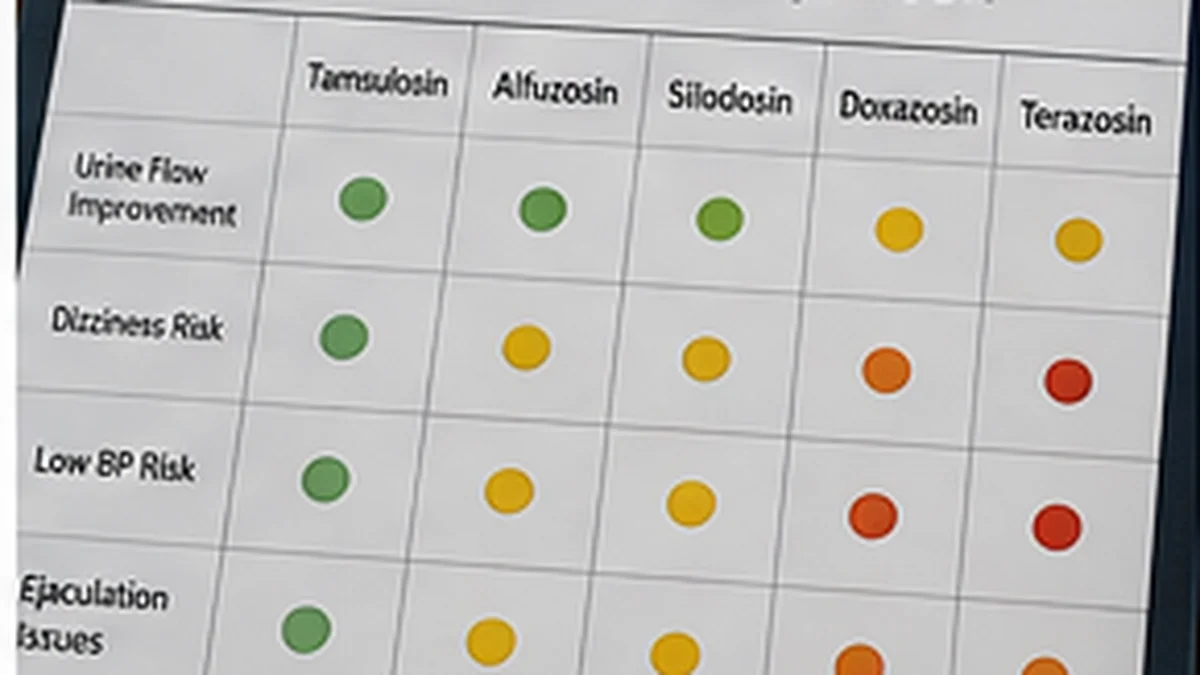
How to use this comparison matrix
The AUA guideline lists alfuzosin, doxazosin, silodosin, tamsulosin and terazosin as alpha-blocker options for bothersome moderate-to-severe LUTS/BPH. It does not declare one universally best. Instead, it tells clinicians to base selection on age, comorbidities and different adverse-event profiles, including ejaculation and blood-pressure effects.
This matrix is therefore organized around those decision variables rather than a simplistic winner/loser score. It is useful for preparing questions, not choosing a prescription without clinical evaluation.
Compare the five guideline-listed alpha blockers
| Medication | Indication context | Blood-pressure consideration | Ejaculation consideration | Decision note |
|---|---|---|---|---|
| Tamsulosin (Flomax) | BPH | Orthostatic symptoms possible | Abnormal ejaculation is recognized | Not a prostate-shrinking drug |
| Alfuzosin (Uroxatral) | BPH | Postural hypotension/syncope warning | Less defined by ejaculation effects than silodosin | Caution with antihypertensives/nitrates |
| Silodosin (Rapaflo) | BPH | Postural hypotension can occur | Retrograde ejaculation prominent in label | Renal dosing matters |
| Doxazosin (Cardura) | BPH + hypertension | Postural hypotension/syncope important | Not usually the defining selection issue | Titration and PDE5 interaction context matter |
| Terazosin (Hytrin) | BPH + hypertension | First-dose/dose-change hypotension prominent | Not usually the defining selection issue | Careful titration/restart context matters |
Why selectivity matters, but does not settle the decision
More uroselective agents can reduce some systemic vascular effects, but selectivity can come with different ejaculation trade-offs. Silodosin makes that particularly obvious: its labeling highlights retrograde ejaculation, while doxazosin and terazosin are often discussed more around systemic blood-pressure effects. Tamsulosin sits in the middle of many real-world comparisons because it is widely used and has recognized ejaculation and orthostatic considerations.
Alfuzosin deserves separate treatment rather than being lumped into a generic alpha-blocker page. Its label warns about postural hypotension and syncope, including greater concern with antihypertensives or nitrates. Depending on patient priorities, a clinician may compare that profile with tamsulosin or silodosin rather than assuming all “uroselective” options behave identically.
What the matrix does not show
It does not tell you whether urinary symptoms are actually caused by BPH, whether the prostate is enlarged enough to justify a 5-alpha-reductase inhibitor, whether tadalafil is relevant, or whether persistent symptoms are better addressed by a procedure. It also cannot incorporate kidney or liver function, cataract plans, exact blood pressure, fall history or drug interactions for one individual.
How to use this information in a treatment decision
BPH treatment is not a contest to find a universally “best” alpha blocker. The American Urological Association lists alfuzosin, doxazosin, silodosin, tamsulosin and terazosin as treatment options for bothersome moderate-to-severe LUTS/BPH, and specifically says selection should take age, comorbidities and differing adverse-event profiles into account. That matters because the drugs share a class but not identical practical trade-offs.
For a useful clinician discussion, bring a short symptom record covering nighttime urination, urgency, weak stream, hesitancy, incomplete emptying, dizziness, falls, blood-pressure readings if relevant, and any sexual or ejaculation changes. Also bring a complete medication list. Alpha blockers can interact with the rest of a treatment plan, and blood-pressure-lowering effects are especially important when antihypertensives, nitrates or PDE5 inhibitors are involved.
Separate short-term symptom relief from long-term progression questions. Alpha blockers improve symptoms by relaxing smooth muscle; they do not shrink the prostate in the same way as finasteride or dutasteride. If prostate enlargement, PSA, progression risk, persistent symptoms or complications are central to the case, the right comparison may extend beyond the alpha-blocker class.
Questions to discuss with your clinician
- Which treatment goal matters most in my case: urinary symptom relief, blood-pressure management, fewer ejaculation effects, or another priority?
- How do my age, fall risk, cardiovascular history and other medicines affect alpha-blocker choice?
- What should I expect during the first days or weeks, and when should response be reassessed?
- Which dizziness, fainting, urinary or sexual symptoms should prompt an earlier call?
- If this alpha blocker is not a good fit, should we compare another alpha blocker, another medication class, combination treatment or a procedure?
الأسئلة الشائعة
Do alpha blockers shrink the prostate?
No. Alpha blockers primarily relax smooth muscle to improve urinary symptoms. Drugs such as finasteride and dutasteride work differently and can reduce prostate volume over time.
Do alpha blockers affect PSA the way finasteride does?
Alpha blockers are not generally used to reduce PSA. PSA interpretation is a different issue with 5-alpha-reductase inhibitors such as finasteride and dutasteride.
Can alpha blockers cause dizziness?
Yes. Dizziness and postural blood-pressure effects are recognized class concerns, although the degree and individual risk differ among drugs.
Why does blood pressure matter when choosing an alpha blocker?
Some alpha blockers have more systemic vascular effects. Age, baseline blood pressure, antihypertensive medicines, fall risk and other drugs can change the practical risk.
Can alpha blockers affect ejaculation?
Yes. Ejaculatory dysfunction is an important treatment-selection issue, particularly with some more uroselective agents. The exact profile differs by drug.
Can two alpha blockers be taken together?
Combining alpha blockers is generally not a routine BPH strategy and can increase adverse effects. Silodosin labeling specifically says it should not be used with other alpha blockers.
What should I tell my eye surgeon?
Tell an ophthalmologist about current or previous alpha-blocker use before cataract surgery because the class is associated with intraoperative floppy iris syndrome.
Can an online page tell me which alpha blocker to use?
No. It can clarify trade-offs and questions, but medication selection requires clinical evaluation of symptoms, blood pressure, other medicines and health history.
What if an alpha blocker is not working?
Persistent symptoms deserve reassessment rather than an automatic dose change. The clinician may review diagnosis, adherence, prostate size, bladder function, another drug class, combination therapy or procedures.
Should I stop an alpha blocker if I feel dizzy?
Do not stop or restart prescription medication solely from an online article. Contact the prescriber, particularly if dizziness is new, severe, recurrent or associated with fainting.
Are alpha blockers used only for BPH?
Some alpha blockers, including doxazosin and terazosin, are also used for hypertension. That dual role is one reason blood-pressure context matters.
When do urinary symptoms need urgent medical care?
Seek urgent evaluation for inability to urinate, severe lower abdominal pain, fever with urinary symptoms, visible blood in urine, fainting or other severe symptoms.
المصادر
Source selection focuses on decision-relevant prescribing and guideline information so readers can distinguish class-wide considerations from medication-specific warnings.
Zenn7 prioritizes U.S. prescribing information, public-health references and clinical guidelines. Links open in a new tab.