Quick answer
Finasteride and Low Libido should be assessed as a specific treatment-tolerance question, not as a generic warning-label search. For finasteride, map low libido against the start date, dose history, urinary benefit and other medicines before deciding how plausible a drug contribution is.
What this page helps you decide
- Start with the exact symptom, not the category label
- Why finasteride belongs in this discussion
- Desire deserves its own question
Evidence used on this page: DailyMed: Finasteride prescribing information · NIDDK: Enlarged Prostate (Benign Prostatic Hyperplasia) · American Urological Association: BPH Guideline
Useful next reads: BPH Medication Side Effects · Finasteride treatment guide
Start with the exact symptom, not the category label
For finasteride and low libido, precision matters. Describe low libido in concrete terms and note what was happening immediately before it. A precise description makes it easier to compare the symptom with the known profile of finasteride.
Timing is especially useful on this page. Ask whether low libido existed before finasteride, appeared soon after treatment began, changed after a dose adjustment, or persisted despite a clinician-directed change. Each pattern points to a different follow-up question.
Why finasteride belongs in this discussion
Before changing finasteride, identify the therapeutic job it is doing. The clinician needs to know whether the goal was faster symptom relief, progression-risk reduction, erectile-function overlap or another reason, because alternatives do not reproduce every benefit equally.
The useful comparison is therefore not simply “finasteride versus no finasteride.” It is the current regimen versus realistic alternatives that still address the person’s BPH goals without creating a worse trade-off elsewhere.
Desire deserves its own question
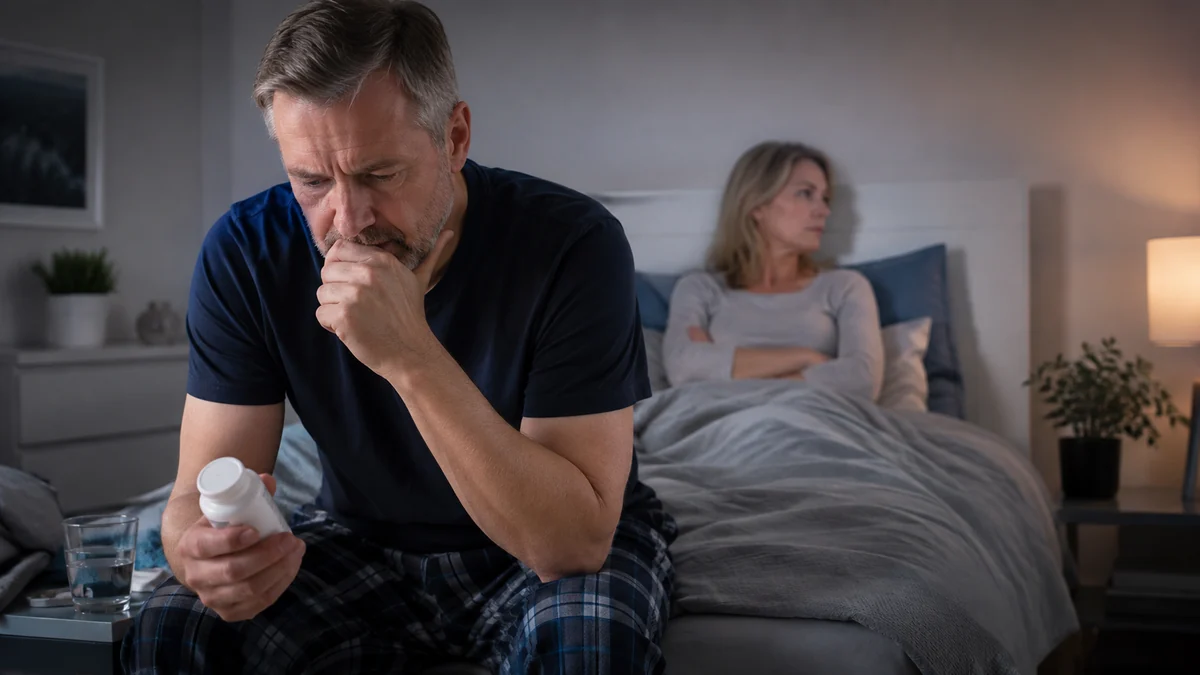
A reduction in sexual interest can exist with normal erections and normal ejaculation. That makes libido a separate treatment-tolerance issue rather than merely a synonym for erectile dysfunction.
Track desire, energy, mood, erection quality, ejaculation, relationship context, sleep and when the change began relative to medication exposure.
Rule out overlapping causes before blaming one medicine
Do not assume a temporal association proves causation. For low libido, the differential may include other prescriptions, age-related changes and non-urologic conditions; the relevant competing causes depend on the symptom itself.
The safest attribution process compares multiple timelines: finasteride, other prescriptions, new illnesses and the symptom itself. That reduces the chance of stopping useful BPH treatment for an unrelated problem or overlooking a genuine interaction.
A decision checklist for this side-effect question
| Baseline | Reconstruct whether low libido existed before finasteride. |
|---|---|
| Reproducibility | Note whether the symptom follows dosing, posture, sexual activity or another trigger. |
| Medication context | Review every prescription, OTC product and supplement alongside finasteride. |
| BPH objective | Identify the original reason this treatment was selected. |
| Follow-up endpoint | Agree on what improvement would count after a supervised adjustment. |
What a clinician may need to reconsider
If low libido is important enough to reconsider finasteride, the prescriber may compare another drug within the same class, a different BPH class, combination therapy or a procedure pathway. The choice should preserve the treatment objective rather than merely remove one medication.
Do not improvise dose changes from an online comparison. A supervised plan matters because changing finasteride can affect urinary symptoms and may interact with blood-pressure, sexual-function or PSA-related considerations depending on the drug class.
When this moves from a tolerability issue to a safety issue
Side-effect optimization stops being the priority when there is a medical emergency. Severe fainting, chest pain, acute retention, a prolonged painful erection or another dangerous change needs urgent care rather than a medication-ranking exercise.
For non-emergency low libido, contact the prescriber with a short chronology and the current medication list. That gives the visit enough structure to decide whether observation, investigation or a treatment change is justified.
Questions to discuss with your clinician
- Was finasteride chosen mainly for symptom speed, prostate biology or another reason?
- Could my other medicines amplify low libido?
- What symptom details would help you distinguish a drug effect from another condition?
- Is there an alternative BPH strategy that better fits my tolerance priorities?
- What should I monitor after any clinician-directed change?
Frequently asked questions
How does finasteride and low libido fit into a medication review?
Frame the issue as a comparison between benefit and burden. The prescriber needs both the symptom story and the BPH response to judge whether finasteride still fits.
What makes low libido more or less likely to be related to finasteride?
A close temporal relationship can increase suspicion, but competing causes and other medicines still matter. Rechallenge or dose changes should never be attempted without clinical direction.
Which details about low libido should I write down?
Write down the first clear episode, how often it recurs, relevant vital signs or sexual-function details when applicable, and all treatment changes made around the same period.
Can I change finasteride on my own because of this problem?
Not without professional guidance. An unsupervised change can confuse the timeline and may allow BPH symptoms to worsen or create interaction problems.
What other causes can resemble this low libido complaint?
A competing explanation is common enough that it deserves explicit review. That does not dismiss a possible medication effect; it makes the attribution more accurate.
How does urinary benefit affect the decision?
The decision is not based on side effects alone. Record whether weak stream, urgency, nocturia or another treatment target improved enough to justify continued exposure.
Could another BPH treatment have a different trade-off?
Another alpha blocker, a different drug class or a procedure may change the trade-offs. Selection requires clinical review because benefits and risks shift together.
What should be on my medication list for this discussion?
Bring the complete list, not just prostate drugs. Interaction or additive effects may explain why a previously stable regimen is now associated with low libido.
When should low libido be reviewed promptly?
If low libido is mild and stable, it may be discussed with the prescriber; if it is dangerous, rapidly worsening or accompanied by major warning signs, seek urgent medical assessment.
Does a procedure guarantee that low libido will disappear?
No. A procedure changes the treatment pathway, not the fact that every option has trade-offs. Candidacy, anatomy, recovery and sexual priorities still need discussion.
What should we measure after changing treatment?
Measure both sides of the change: whether low libido improves and whether the BPH symptoms that finasteride was treating remain controlled.
What is the safest takeaway from this page?
The safest takeaway is to document the pattern, review it with the treating clinician and avoid unsupervised changes to finasteride.
Evidence used on this page
Major treatment claims are anchored to the sources cited on this page, prioritizing official drug labeling, government health agencies, regulators, and professional guidelines.
- Official drug labeling
- Government health source
- Professional guideline
Sources
Zenn7 prioritizes U.S. prescribing information, public-health references and clinical guidelines. Source links open in a new tab.