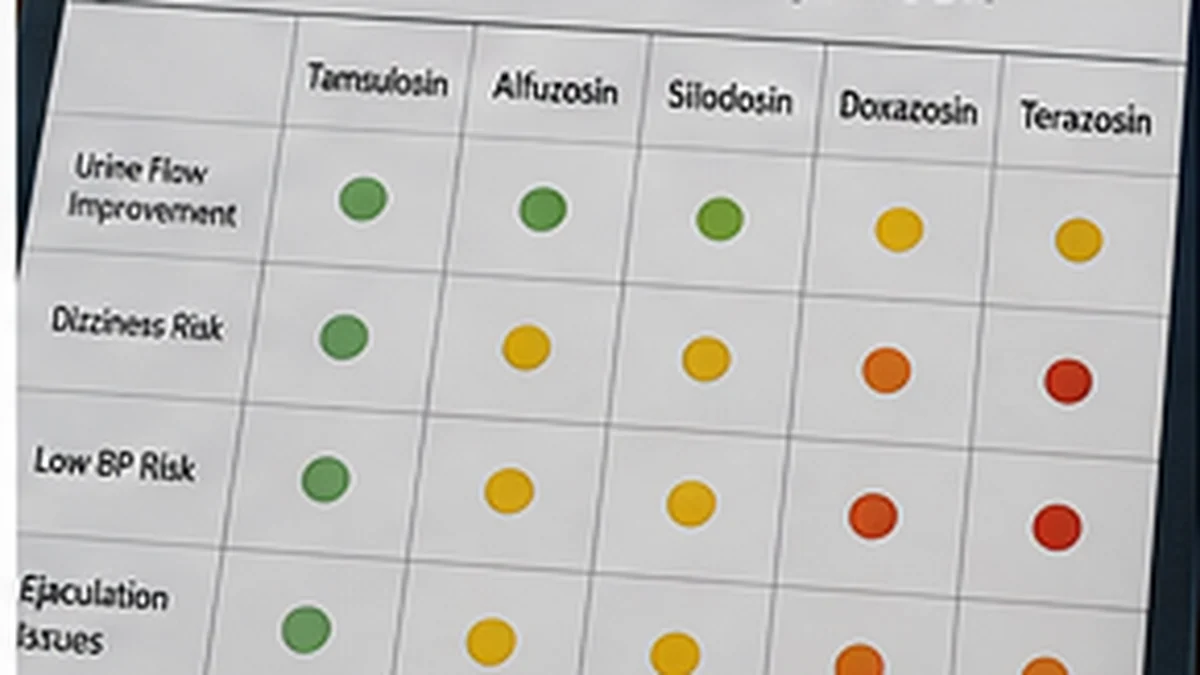
Quick answer
Tamsulosin and Terazosin can both appear in BPH BPH care approach plans, but they are not interchangeable. Both can relieve BPH bothersome urinary issues, but postural blood-pressure effects and titration are more central with terazosin. The better fit depends on standing dizziness, blood-pressure goals, fall risk, titration and ejaculation concerns.
What this page helps you decide
- Urinary selectivity versus titrated systemic alpha blockade
- Side-by-side care selection table
- Why Tamsulosin versus Terazosin is a distinct decision
Evidence used on this page: NIDDK: Enlarged Prostate (BPH) · DailyMed drug labeling · American Urological Association: BPH guidance
Useful next reads: Tamsulosin guide · Terazosin guide · Compare BPH medications
Urinary selectivity versus titrated systemic alpha blockade
Tamsulosin is a selective alpha-1 blocker that relaxes smooth muscle around the prostate and bladder outlet. Terazosin is a non-uroselective alpha blocker that relaxes prostate/bladder-neck smooth muscle while also affecting systemic orthostatic pressure profile. Because both are used primarily to reduce the dynamic resistance created by smooth muscle around the outlet, prostate shrinkage is not the purpose of either drug.
The meaningful comparison therefore sits in tolerability and context. With Tamsulosin, can cause dizziness or postural blood-pressure bothersome urinary issues; with Terazosin, postural hypotension and dizziness are prominent practical considerations. changes in sexual function also deserve separate discussion: ejaculatory changes can matter for some men, whereas sexual trade-offs exist but usually sit alongside blood-pressure tolerability.
That means a previous episode of standing dizziness, a history of falls, use of antihypertensive medicines, and the importance of ejaculation or sexual function can be more useful care selection variables than simply asking which alpha blocker is “stronger.”
Side-by-side care selection table
| care selection factor | Tamsulosin | Terazosin |
|---|---|---|
| Drug class | Selective Alpha-1 Blocker | Non-Uroselective Alpha Blocker |
| Primary BPH care approach aim | Relaxes smooth muscle around the prostate and bladder outlet | Relaxes prostate/bladder-neck smooth muscle while also affecting systemic orthostatic pressure profile |
| prostate-volume context | Does not shrink the prostate | Does not shrink prostate tissue |
| Practical timing | Often used when relatively prompt symptom relief is the chief goal | Can improve bothersome urinary issues but is typically titrated with blood-pressure tolerance in mind |
| Blood-pressure context | Can cause dizziness or postural blood-pressure bothersome urinary issues | Postural hypotension and dizziness are prominent practical considerations |
| Sexual-function discussion | Ejaculatory changes can matter for some men | Sexual trade-offs exist but usually sit alongside blood-pressure tolerability |
| PSA context | Does not have the psa-lowering effect associated with 5-alpha-reductase inhibitors | Does not create 5-ari-style psa suppression |
This comparison is educational. Individual suitability depends on medical history, prostate characteristics, orthostatic pressure profile, other medicines, BPH care approach goals and urology team judgment.
Why Tamsulosin versus Terazosin is a distinct decision
Tamsulosin and Terazosin should not be compared as though they are interchangeable names on the same prescription shelf. Tamsulosin is best understood as a uroselective alpha blocker, while Terazosin is a nonselective alpha-1 blocker. That difference changes what “success” means, how quickly a response is judged, which adverse effects deserve attention, and what information should be reviewed before switching.
The most useful comparison lens for Tamsulosin is fast urinary symptom relief and ejaculation trade-off. For Terazosin, the central lens is older alpha-blocker strategy where BP, titration and fall risk dominate. A patient whose main priority is rapid relief, blood-pressure stability, ejaculation preservation, erectile function, prostate shrinkage or PSA interpretation can therefore reach a different conclusion even when both treatments are reasonable options.
| Decision factor | Tamsulosin | Terazosin |
|---|---|---|
| Treatment identity | uroselective alpha blocker | nonselective alpha-1 blocker |
| Blood-pressure lens | generally less systemic BP effect than older nonselective agents | orthostatic hypotension and first-dose effects deserve explicit planning |
| Sexual-function lens | ejaculation changes are a key counseling point | sexual trade-offs are secondary to vascular tolerability in many decisions |
| Dosing/timing issue | usually fixed-dose rather than BP titration | gradual titration is central |
| Best framing | fast urinary symptom relief and ejaculation trade-off | older alpha-blocker strategy where BP, titration and fall risk dominate |
Patient scenarios where the Tamsulosin–Terazosin choice changes
If the dominant problem is weak stream with a need for relatively rapid symptom relief, the comparison should emphasize onset and tolerability rather than long-term structural effects. If the dominant concern is a large prostate or progression risk, the relevance of each mechanism changes. If sexual function is the reason for reconsidering treatment, the conversation should separate erectile function from ejaculation because those are not the same outcome.
Blood pressure also changes the decision. For Tamsulosin, generally less systemic BP effect than older nonselective agents. For Terazosin, orthostatic hypotension and first-dose effects deserve explicit planning. That matters more in someone with antihypertensive therapy, orthostatic symptoms, falls risk or cardiovascular constraints than it does in a patient without those issues.
Dosing details can also decide the practical winner. With Tamsulosin, usually fixed-dose rather than BP titration. With Terazosin, gradual titration is central. Adherence and administration details are not glamorous, but neither is publishing a comparison that ignores the reason a drug fails in real life.
Questions that are specific to choosing between Tamsulosin and Terazosin
- Which of my symptoms is Tamsulosin most likely to improve, and which is Terazosin most likely to improve?
- How soon should I expect a meaningful response from each option before we judge it?
- Which adverse effect is most likely to make me stop Tamsulosin, and which is most likely with Terazosin?
- Does my blood pressure, fall risk or cardiovascular medication list favor one option?
- Do prostate size, PSA interpretation or risk of progression change the value of either drug?
- If the first choice is inadequate, would switching, combining therapy or discussing a procedure make more sense?
Frequently asked questions about Tamsulosin versus Terazosin
What is the biggest practical difference between Tamsulosin and Terazosin?
Tamsulosin is a uroselective alpha blocker, whereas Terazosin is a nonselective alpha-1 blocker. That difference changes the expected response timeline, monitoring priorities and the reasons a clinician might prefer one over the other.
Which works faster for urinary symptoms, Tamsulosin or Terazosin?
For Tamsulosin, the response window often judged over days to a few weeks for symptom relief. For Terazosin, it response depends partly on gradual titration to a tolerated dose. The comparison should use an appropriate timeline for each mechanism rather than declaring one a failure too early.
How do Tamsulosin and Terazosin differ on blood-pressure risk?
With Tamsulosin, can still cause dizziness or orthostatic symptoms, but blood-pressure treatment is not its purpose. With Terazosin, first-dose and orthostatic blood-pressure effects require deliberate planning. Baseline blood pressure, antihypertensive medicines, dizziness and fall history can therefore change which option is easier to tolerate.
Which has the more important sexual-function trade-off?
For Tamsulosin, ejaculatory changes are a prominent counseling issue. For Terazosin, sexual effects are not usually the dominant differentiator. Erectile function, libido and ejaculation should be discussed separately because one treatment can affect these domains differently.
Does Tamsulosin or Terazosin shrink an enlarged prostate?
Tamsulosin: does not shrink the prostate. Terazosin: does not shrink the prostate. This matters when prostate volume or long-term progression risk is central to the treatment goal.
How do Tamsulosin and Terazosin affect PSA interpretation?
Tamsulosin: does not materially suppress PSA. Terazosin: does not materially suppress PSA. If either treatment changes PSA biology, the clinician should interpret serial values in that treatment context.
Which patient priority most strongly favors Tamsulosin?
The strongest reason to focus on Tamsulosin is usually administration consistency and ejaculation priorities. That priority should still be weighed against symptom pattern, prostate anatomy, other medicines and adverse-effect tolerance.
Which patient priority most strongly favors Terazosin?
The strongest reason to focus on Terazosin is usually slow titration, fall risk and blood-pressure context. It becomes more relevant when that issue matters more than the advantages offered by Tamsulosin.
Can a clinician switch directly from Tamsulosin to Terazosin?
Switching depends on why Tamsulosin is being stopped, how Terazosin works, interaction risk and whether a washout or overlap is appropriate. The prescriber should give the specific transition plan rather than the patient improvising one.
Could Tamsulosin and Terazosin ever be used together?
Combination therapy makes sense only when the mechanisms and safety profile complement each other. Some BPH drug classes are intentionally combined, while pairing two treatments with overlapping effects may add risk without enough benefit.
What if neither Tamsulosin nor Terazosin controls the main symptom?
Persistent symptoms should trigger a reassessment of the symptom driver, adherence, treatment duration and anatomy. Urgency, nocturia and weak flow do not always share the same cause, and medication comparisons cannot rule out bladder, sleep, infection or obstruction-related contributors.
When should the Tamsulosin versus Terazosin decision become a procedure discussion?
A procedure discussion becomes more relevant when bothersome symptoms persist despite an adequate medical strategy, adverse effects make medication difficult to continue, or objective findings suggest that medication alone is unlikely to meet the treatment goal.
Evidence used on this page
Major treatment claims are anchored to the sources cited on this page, prioritizing official drug labeling, government health agencies, regulators, and professional guidelines.
- Government health source
- Official drug labeling
- Professional guideline
Sources
Sources are provided for general medical context. Drug labeling and professional guidance can change; clinicians should use current prescribing information and guidelines.
Related BPH care approach decisions
Medical note: This page is educational and does not diagnose BPH or tell you to start, stop, or change a prescription. Seek prompt care for urinary retention, fever with urinary bothersome urinary issues, severe pain, or substantial blood in the urine.